
Action Research in Practice: Why Organizations Must Understand Their Unconscious Patterns
A systems perspective on the Tavistock tradition and its relevance for modern leaders

When I work with organizations, I keep encountering the same phenomenon over and over again - executives complaining that change processes don't unfold as planned, that resistance emerges from nowhere, and that teams behave in ways that are almost impossible to explain rationally. And I often think to myself: what's missing here is a deeper understanding of what's happening beneath the visible surface of the organization.
The Tavistock Institute of Human Relations developed an approach back in the 1940s, building on Kurt Lewin's groundbreaking work on Action Research, that puts these hidden dynamics front and center (Tavistock Institute, 2024). What fascinates me about this approach is how it connects practical organizational development with deeper psychoanalytic and systems theory insights - something we neglect far too often in today's consulting landscape.
The Organization's Unconscious: More Than Just Group Dynamics
Action Research, as practiced at the Tavistock Institute, is fundamentally different from what we normally think of as organizational research. This isn't just about data collection and analysis, but about a participatory, iterative process where researchers and participants work together as "co-investigators" (Tavistock Institute, 2024). This means the people involved aren't passive objects of study, but active shapers of the learning process.
What particularly appeals to me is the theoretical foundation: the combination of psychoanalytic theory (to understand unconscious processes), group relations theory (to capture interaction patterns), and open systems theory (to grasp interactions with the environment). These three pillars create a systemic understanding that goes way beyond surface-level change management approaches.
Isabel Menzies Lyth: How Anxiety Shapes Organizations
One example that keeps impressing me is Isabel Menzies Lyth's study of defense mechanisms in hospitals. She showed how nurses developed rigid, depersonalized routines to cope with the emotional strain of dealing with illness and death (Tavistock Institute, 2024). This is something I observe in many organizations - not just in healthcare.
Let me make this concrete: I recently worked with a tech company where a similar pattern emerged. The development teams had introduced increasingly detailed processes and controls over the years - officially for "quality assurance." Looking deeper, it turned out these mechanisms primarily served to manage anxiety about making mistakes and facing the consequences. The problem? These defense mechanisms were massively hindering innovation and flexibility.
This is where Action Research comes in - by encouraging participants to reflect on their own experiences and make these unconscious structures conscious.
Gordon Lawrence and Social Dreaming: Creative Access to the Collective Unconscious
I find Gordon Lawrence's approach of "Social Dreaming" particularly fascinating. Here participants share their dreams in a group setting and explore the symbolic meanings and associations together (Tavistock Institute, 2024). This might seem esoteric at first glance, but from a systems perspective, it makes absolute sense.
Dreams, when we view them systemically, are expressions of collective unconscious processes. They reflect anxieties, hopes, and tensions that are present in the organization but can't be articulated. I call it the "emotional fingerprint" of the organization - something that can't be captured through rational analysis methods.
Eric Miller and Boundary Work: Leadership as Systems Management
Eric Miller's focus on the relationship between individual, group, and the broader organizational system brings another important dimension into play (Tavistock Institute, 2024). From my perspective, this is one of the central points for modern leadership work: the ability to manage boundaries - both between different subsystems within the organization and between the organization and its environment.
Here's how this works in practice: effective leaders aren't just managers of tasks and processes, but "boundary managers" - they understand how information, energy, and influences flow between different systems and can consciously shape these flows.
My Systems Hypothesis: The Organization as Learning System
Based on the Tavistock approaches and my own experience in systemic organizational development, I'm developing the following hypothesis:
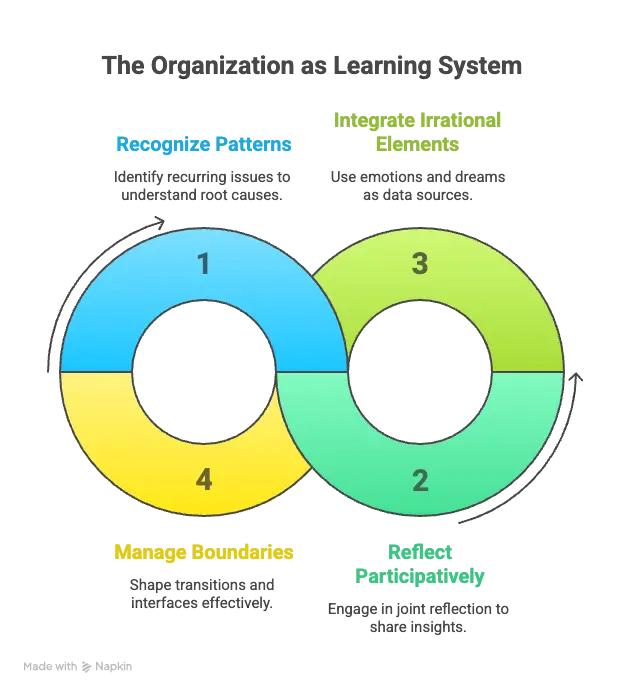
Organizations are living systems with a collective unconscious that manifests in recurring patterns, defense mechanisms, and emergent behaviors. Sustainable change is only possible when these unconscious dynamics are made conscious and actively integrated into the development process.
This means concretely:
Pattern recognition instead of symptom fighting: Rather than solving individual problems, we need to understand the underlying patterns that keep producing these problems.
Participatory reflection: Change doesn't happen through external consulting, but through joint reflection by participants on their own experiences and perceptions.
Integration of the irrational: Emotions, anxieties, dreams, and other "irrational" elements aren't disruptive factors, but important sources of information about the system's state.
Boundary management: Leadership becomes the art of boundary management - consciously shaping transitions and interfaces between different systems.
3 Daily Habits for Systems-Thinking Leaders
Let me make this practical with three daily habits I derive from the Action Research tradition:
1. The 10-Minute Reflection Check (morning) Ask yourself daily: "What recurring patterns am I observing right now in my team/organization? What might this say about unconscious dynamics?" Note your observations - often patterns only become visible over time.
2. Boundary Analysis (midday) Take 10 minutes to analyze: "What boundaries have I crossed or defended today? Which systems am I moving between and how am I influencing the flow of information and energy?" This sharpens awareness of your own role as boundary manager.
3. The Emotion Barometer (evening) Reflect: "What emotions and irrational impulses did I perceive in myself and others today? What might these tell us about our organization's state?" Treat these perceptions as valuable system information, not disturbances.
Conclusion: From Intervention to Dialogue
Action Research, as developed at the Tavistock Institute, offers us a framework for understanding organizations not just as mechanical systems, but as living, learning organisms with conscious and unconscious dimensions. This is debatable, but in my experience, it's the key to sustainable organizational development.
The difference from traditional consulting approaches is that we don't intervene from the outside, but engage in reflective dialogue together with the organization. This might take longer and be less predictable, but it leads to deeper and more sustainable changes.
Maybe that's the most important point: organizational development transforms from mechanical problem-solving to organic learning process - and that requires a fundamentally different attitude from us as leaders and consultants.
Source: Tavistock Institute of Human Relations (2024). What is Action Research? A participatory and iterative way of conducting research in organisations and other systems. Available at: https://tavinstitute.org/news/what-is-action-research
(posted 30.10.2024, accessed on 25.5.2025)
The author is a systems-oriented organizational developer and coach with over 30 years of experience supporting transformation processes in mid-market and large enterprises.